
How to Search Saginaw County Traffic Court Records
Saginaw County traffic cases are searchable through the Saginaw County Court Case and Hearing Information portal, the same Odyssey system that carries the county's civil, criminal, and probate cases. The portal at secure.saginawcounty.com/OdysseyCourtInformation lets anyone look up open and closed matters at no charge. Setting the Court filter to Traffic keeps the results limited to citations rather than pulling every case tied to a name. The site is a public service, not the official record, and it clearly states that case documents are not available online.
Have a few details ready before you start. The citation or ticket number returns the cleanest result, since it points to one exact case. A driver name works too, entered as Last, First Middle Suffix, though common names can produce several matches. The issuing agency, the file dates, and the driver's court date all help narrow a broad search. A Google reCAPTCHA check must be cleared before the system will run the query, so plan to search from a full browser rather than an automated tool.
The traffic portal is one slice of the broader set of Saginaw County court records that flow through the same search screen. Once a matching case appears, the result confirms the court, the charge, the hearing schedule, and how the matter was resolved.
- Open the Odyssey portal and choose "Search for a Court Case" for the case file or "Search for a Court Docket" for upcoming hearings.
- Enter the citation or ticket number when you have it, or type the driver's name in Last, First Middle Suffix order.
- Set the Court dropdown to Traffic, and use the Police Agency filter to match the department that wrote the ticket.
- Clear the reCAPTCHA check and submit the search, then open the matching case to review the charge, court date, and disposition.
- Pay the balance, request a hearing, or ask the traffic counter about a certified copy if you need the official document.
Note: The portal warns that name searches can be unreliable because people share names and some defendants use aliases, so a ticket number is always the safer key.
Which Courts Handle Traffic Cases in Saginaw County
Nearly every Saginaw County traffic matter runs through the 70th District Court Traffic Division on the third floor of the Governmental Center at 111 S. Michigan Avenue. The division processes civil infractions and misdemeanor traffic offenses issued anywhere in the county, whether the ticket came from Saginaw City Police, the county sheriff, the Michigan State Police, a campus force like SVSU Police, or a township agency. Its traffic counter and phone line handle admissions, hearing requests, and payments.
A small number of driving cases reach a higher court. The most serious offenses, such as operating while intoxicated causing death, begin in the District Court Criminal Division and can be bound over to the 10th Circuit Court. The Circuit Court also hears appeals from District Court traffic rulings. The Traffic Division's own Traffic Division page lays out how it handles civil infractions, license suspensions, set-aside motions, and misdemeanor traffic charges.
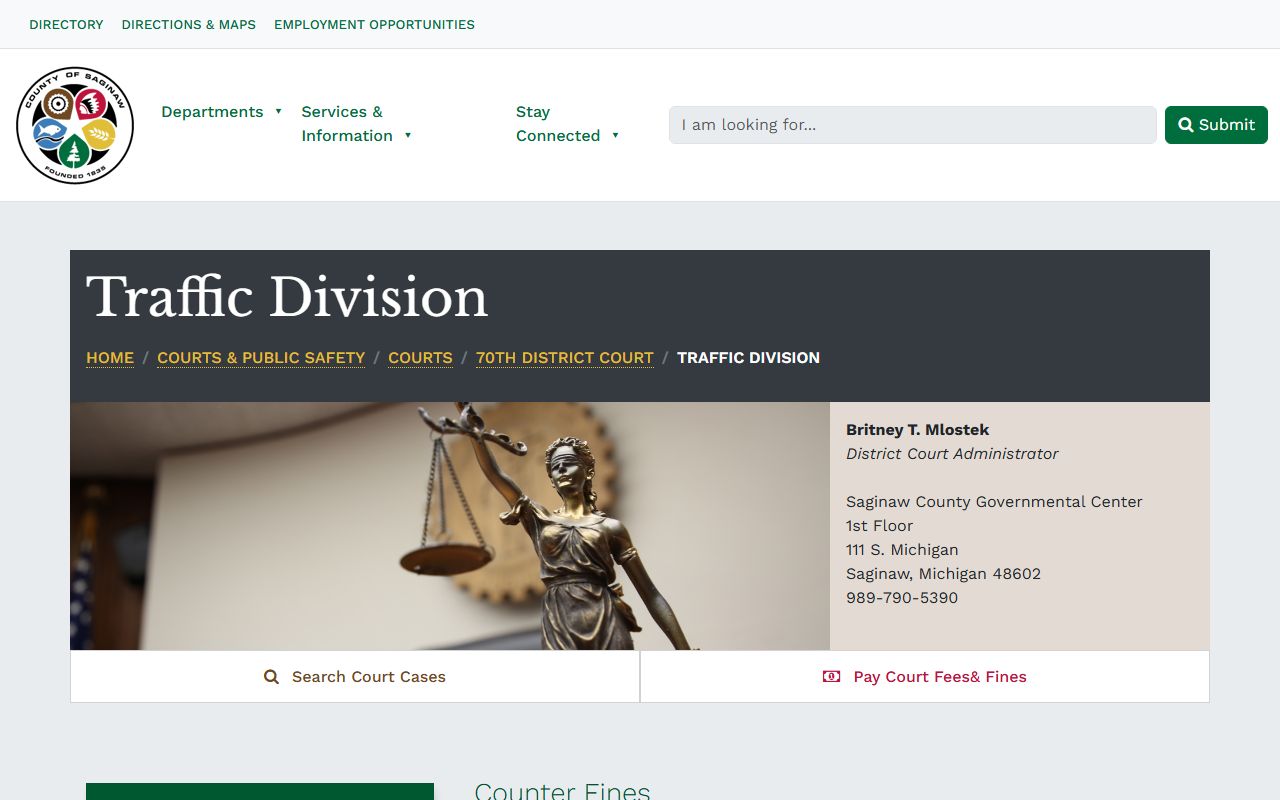
That page is the best starting point for confirming which counter to visit and which phone line to call before a court date.
70th District Court Traffic Division
111 S. Michigan Avenue, 3rd Floor
Saginaw, MI 48602
Phone: (989) 790-5390
Traffic counter hours: Monday through Friday, 8:00 a.m. to 4:30 p.m.
Filings and payments are not accepted after 4:45 p.m.
Types of Traffic Cases on Record
Saginaw County traffic records fall into two broad camps. Civil infractions are non-criminal violations resolved by paying a set fine or asking for a hearing. Misdemeanor traffic offenses are treated as crimes, carry possible jail time, and require a court appearance. The record for each type looks different, and knowing which one a ticket is tells a driver how much is at stake and what the deadline really means.
Many civil-infraction fines are fixed by a published fine schedule that the court uses for mail-in payments. Drivers who plan to admit responsibility can look up the amount, sign the back of the ticket, and send both to the court.
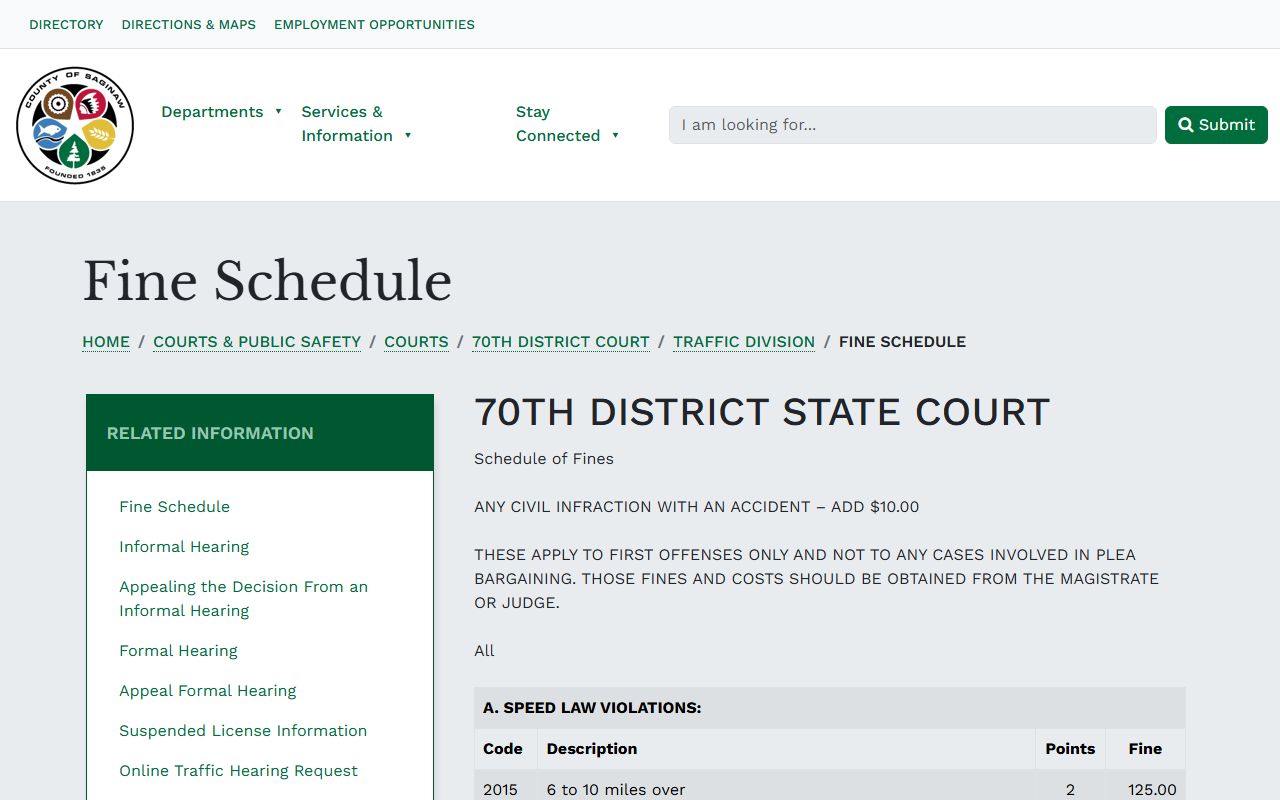
The fine schedule is the reference the Traffic Division points drivers to for the standard cost of a civil infraction. The main categories on file include the following.
- Civil infractions - speeding, improper lane use, and similar non-criminal violations resolved by fine or hearing.
- Misdemeanor traffic offenses - more serious charges carrying a penalty that can run from 90 days to one year in jail.
- Failure-to-comply matters - unpaid or ignored tickets that lead to a default judgment and license suspension.
- Commercial vehicle offenses - violations tied to a commercial license, handled under stricter rules.
- Driving felonies - the gravest offenses, which start in District Court and can move to Circuit Court.
What Saginaw County Traffic Court Records Show
A traffic case file is a running account of the citation from the moment it was filed. It names the charge, the court, and the issuing agency, then tracks each step through the plea, any hearing, and the final judgment. Because the county portal shows case data rather than scanned documents, the fields below are what a driver can expect to see on screen, with the paper record available for a fee at the court office.
| Field | What It Shows |
|---|---|
| Citation / Case Number | The ticket or case number assigned when the citation was filed with the court. |
| Charge and Statute | The violation cited and the Michigan law or local ordinance it falls under. |
| Court and Judge | The Traffic Division as the venue and the judge or magistrate assigned. |
| Issuing Police Agency | The department that wrote the ticket, from city police to the state police or a township unit. |
| Court Date / Hearing | Scheduled arraignment, informal hearing, or formal hearing dates. |
| Plea or Admission | Whether responsibility was admitted or the charge was contested. |
| Disposition | The outcome: paid, dismissed, found responsible, convicted, or defaulted. |
| Fines and Costs | Amounts ordered and the balance still owed to the court. |
| Enforcement Actions | Default judgment, a license-suspension notice, or a bench warrant on a missed misdemeanor date. |
Searching by Citation Number vs by Name
The citation number is the fastest and most accurate way in, because it maps to one case and skips the guesswork. A name search casts a wider net and can return several people, especially with common surnames, so it works best when the driver's exact name and rough date range are known. The county portal itself flags that shared names and aliases make name results less dependable. The search screen accepts the same fields for traffic that it uses for other case types, with the Traffic court filter added.
| Search Field | Type | Required | Notes / Format |
|---|---|---|---|
| Case Number (any part) | Text | No | Enter the ticket or case number when known; the most reliable option. |
| Party Name | Text | No | Last, First Middle Suffix; try spelling variations. |
| Court | Dropdown | Yes | Select Traffic to limit results to citations. |
| Police Agency | Dropdown | No | Filter by the issuing agency, including township ticketing entries. |
| Hearing Dates | Date range | No | Used in docket search for upcoming traffic hearings. |
| Display Order | Dropdown | No | Sort results by hearing date, party, judge, or court. |
Paying or Contesting a Saginaw County Traffic Ticket
The 70th District Court takes traffic payments in person, by mail, and online, but not by telephone. Mailed payments should use a money order, certified check, or credit card made payable to the 70th District Court, with the case or ticket number written on it, and cash should never be mailed. The court accepts MasterCard, VISA, Discover, and American Express on its payment site, and personal checks are no longer accepted. Online traffic payments go through the District Court's payment portal.
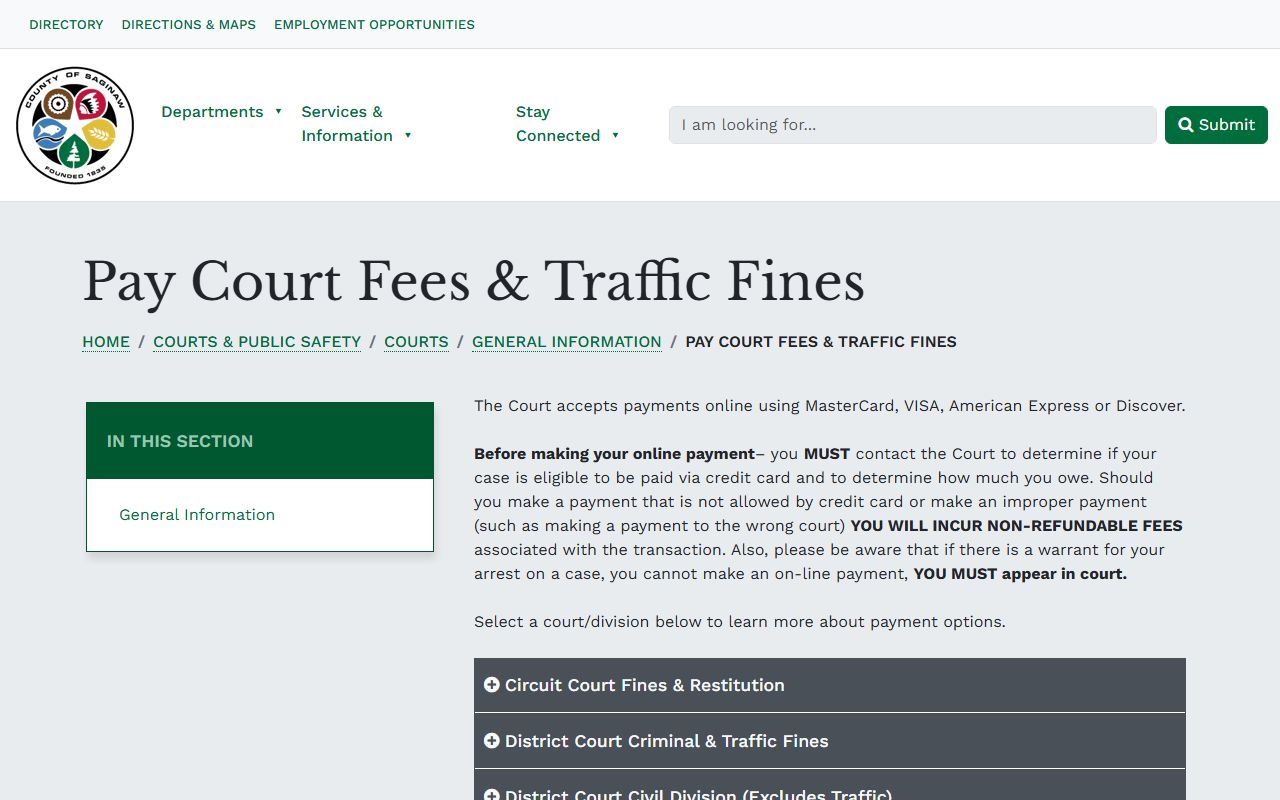
The county's pay court fees and traffic fines page gathers the links for District Court traffic and criminal payments in one place. Paying is only one path; a driver can also fight the ticket instead of admitting to it. The steps below walk through both routes from the day the citation arrives.
- Read the back of the citation for the response deadline and whether the ticket is a civil infraction or a misdemeanor.
- To admit responsibility for a civil infraction, check the fine schedule for the amount and mail the signed ticket with payment, or pay online.
- To contest the ticket, request an informal or formal hearing instead of paying, before the deadline passes.
- Pay online, by mail to the Traffic Division, or in person at the traffic counter using an accepted payment method.
- Keep the receipt or confirmation as proof that the balance cleared.
- If a license was already suspended, appear or pay first, then buy the required clearance card.
Warning: You cannot pay a traffic case online when a warrant is attached to it. The court requires you to appear in person to resolve a case tied to a warrant.
Requesting an Informal or Formal Hearing
Drivers who want to challenge a civil infraction do not simply skip payment; they ask the court for a hearing. Michigan traffic procedure generally offers two paths. An informal hearing is the lighter option, where the driver explains the situation to a magistrate or judge. A formal hearing follows court rules more closely and allows attorneys. The Traffic Division links drivers to informal hearings, formal hearings, and the related appeal and Claim of Appeal forms.
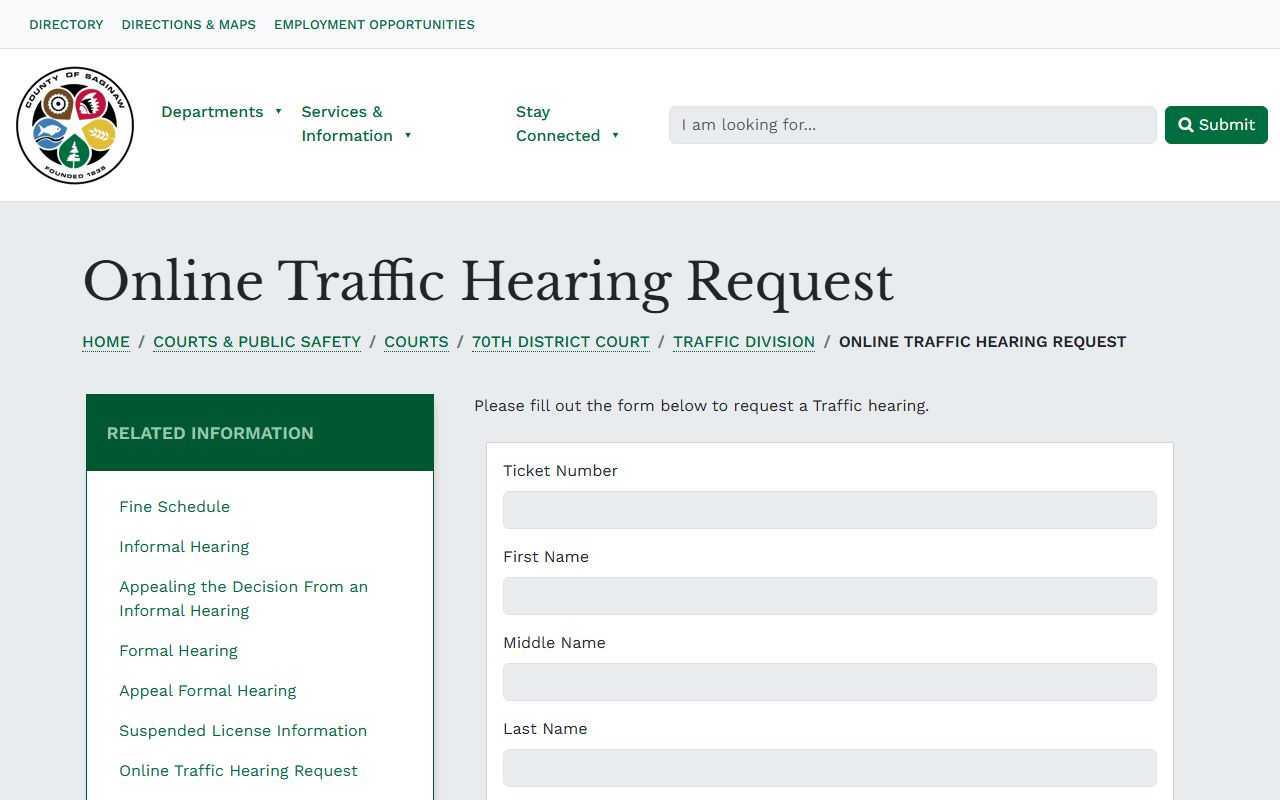
The online traffic hearing request page is the starting point for asking the court to set a hearing date. Michigan does not use the deferred-adjudication or defensive-driving-course model that some other states offer for dismissing a ticket, so the hearing route is the main way a driver seeks a reduction or a dismissal here. If a hearing does not go the driver's way, the appeal and Claim of Appeal forms explain the next step.
Public Access Laws for Traffic Court Records
Traffic cases are court records, so access is governed mainly by Michigan court rules rather than by ordinary county records law. The clerk of the court keeps the file, and the public may inspect open court records within that framework. The county's Freedom of Information Act process is the fallback for administrative or law-enforcement records that fall outside the case file, subject to statutory exemptions that protect ongoing investigations and personal privacy.
Key Rules and Statutes:
Michigan Court Rule 8.119 - court clerks maintain court records and provide public access within the court-record framework.
Michigan FOIA, MCL 15.231 - states a public policy favoring access to public bodies, while court case files stay under court rules.
Court Traffic Records vs State Driver Records
The court file and the driving record are two separate documents, and mixing them up is the most common traffic-records mistake. The 70th District Court holds the case record, which tracks the citation and its outcome. The Michigan Secretary of State holds the driving record, which reports convictions, points, and license status statewide. A ticket resolved in Saginaw County shows up on both, but each office controls its own file and its own correction process.
| Comparison Point | Court Traffic Record | State Driver Record |
|---|---|---|
| Record source | 70th District Court Traffic Division and the county Odyssey portal | Michigan Secretary of State |
| What is in it | Citation, court dates, pleas, judgment, fines and costs, defaults | License status, reported convictions, points, suspensions, reinstatement status |
| Where to access | County case portal or the District Court traffic counter | Michigan SOS driving records service |
| How to correct errors | Raise it in the case with the Traffic Division | Contact the Secretary of State driving records office |
Points never appear on the court file; the Secretary of State assigns them to the driving record after a conviction is reported. Order a Michigan driving record through the Secretary of State driving records service when you need license status or point totals rather than the court case detail.
Note: A cleared court balance does not automatically restore a suspended license; the Secretary of State handles reinstatement and its own fee once the court judgment is satisfied.
CDL and Commercial Driver Records
Commercial driver's license holders face stricter treatment for traffic violations, and Saginaw County citations tied to a commercial vehicle are handled with that in mind. Convictions are reported to the Michigan Secretary of State and posted to the commercial driving record, where they can affect a driver's livelihood. Commercial-vehicle-related offenses are also among the categories that Michigan law excludes from the traffic set-aside process, so they are harder to clear later.
Because the stakes are higher, CDL drivers should confirm both the court outcome and how the conviction was reported to the state. Checking the case in the county portal covers the court side, while the Secretary of State driving record covers the license and reporting side.
DUI and OWI Cases
Drunk and drugged driving charges are not ordinary traffic tickets. Michigan treats operating while intoxicated as a criminal offense, so these cases move through arraignment, pretrial, and sentencing rather than the civil-infraction fine schedule. The most serious versions, such as an offense causing death, can be bound over to Circuit Court.
For the full case file, charges, plea, and sentence on a driving crime, see the Saginaw County criminal court records page.
Sealing or Expunging Traffic Records
Michigan lets some traffic convictions be set aside, which removes them from public view for most purposes, but the door is narrow. The set-aside statute for traffic offenses carves out major exceptions. Operating while intoxicated, traffic offenses that caused injury or death, and commercial-vehicle-related offenses cannot be handled the same way as ordinary eligible convictions.
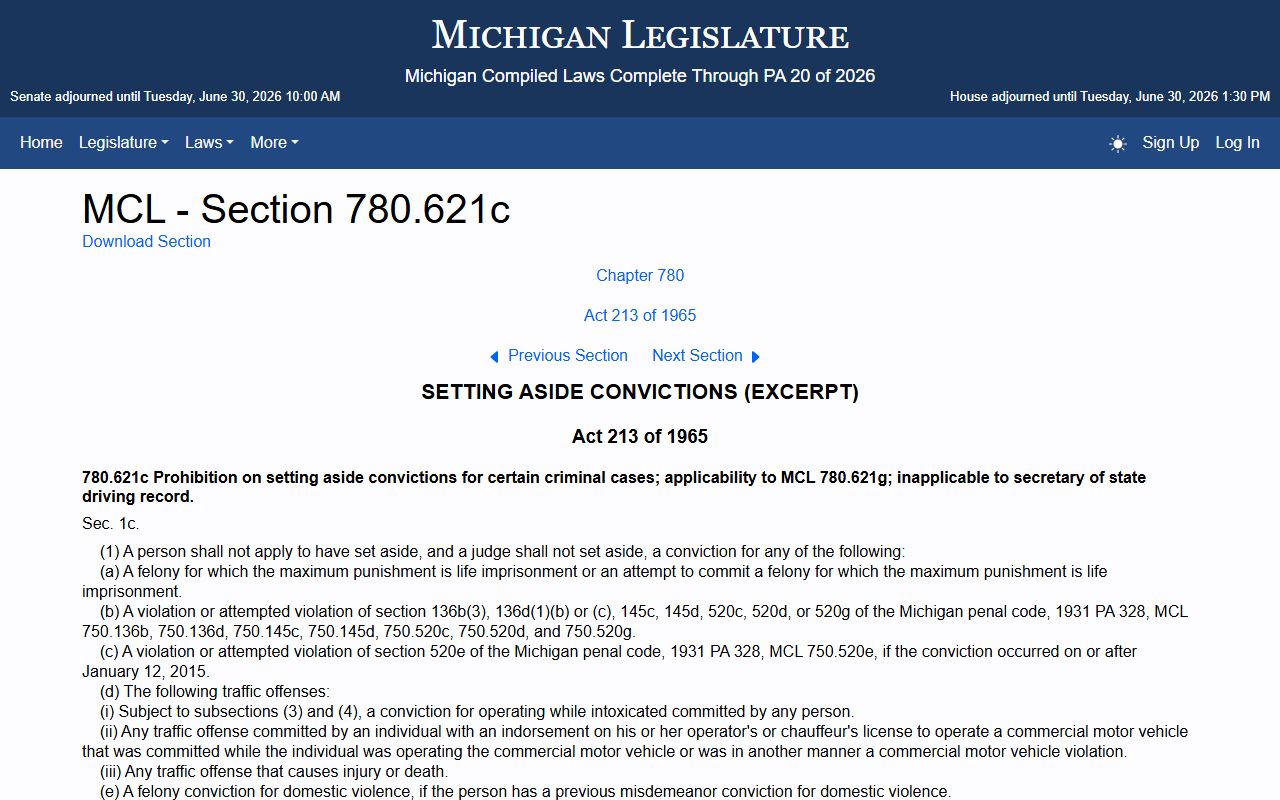
The traffic set-aside statute, MCL 780.621c, spells out which offenses qualify and which are excluded. A person files the request in the court where the conviction happened, using the state-approved set-aside application, and a separate application is needed for each court. Set-aside is not the same as exoneration, and some law-enforcement and court uses of the record continue even after it is granted.
Note: Because eligibility and waiting periods change under Michigan's Clean Slate framework, confirm current rules with the court before filing a set-aside application.
Fees for Traffic Record Copies
The county portal is free to search, but paper and certified copies of a traffic case carry a fee at the court office, and certain traffic actions have their own set charges. Specific civil-infraction fine amounts are not fixed here; those come from the published fine schedule the Traffic Division uses. The figures below cover the record-copy and related court fees drivers most often encounter.
| Item | Amount |
|---|---|
| Driver's license clearance card | $45.00 |
| Motion to Set Aside Default Judgment (civil infraction) | $5.00 |
| Court record copy, per page | $1.00 |
| Certification of a copy | $10.00 plus $1.00 per page |
| Record search by mail, per name | $10.00 |