
Saginaw County Arrest Records and Court Charges
A Saginaw County arrest record is the account of the arrest itself. It notes who was taken into custody, the agency that made the arrest, the date and place, and the booking that follows at the jail. An arrest is an accusation. It is not proof of guilt, and it does not set the specific criminal charges on its own. Those charges come next. After a police agency finishes its investigation, the case goes to the Saginaw County Prosecuting Attorney, who decides what charges to bring and files them with the court. At that point the charge record begins.
It helps to keep the two records apart. The arrest and booking side sits with the Saginaw County Sheriff, and the jail roster and booking detail are covered on the Saginaw County inmate records page. The court charge record is a separate file. It shows what the prosecutor actually filed and how those charges move as the case proceeds. The court charges after arrest are tracked through the case number, hearing dates, and disposition. The full case file, plea, and sentence live in the criminal case record.
The Saginaw County Prosecuting Attorney is the office that turns an arrest into charges. Its role and contact details are described on the Prosecuting Attorney page.
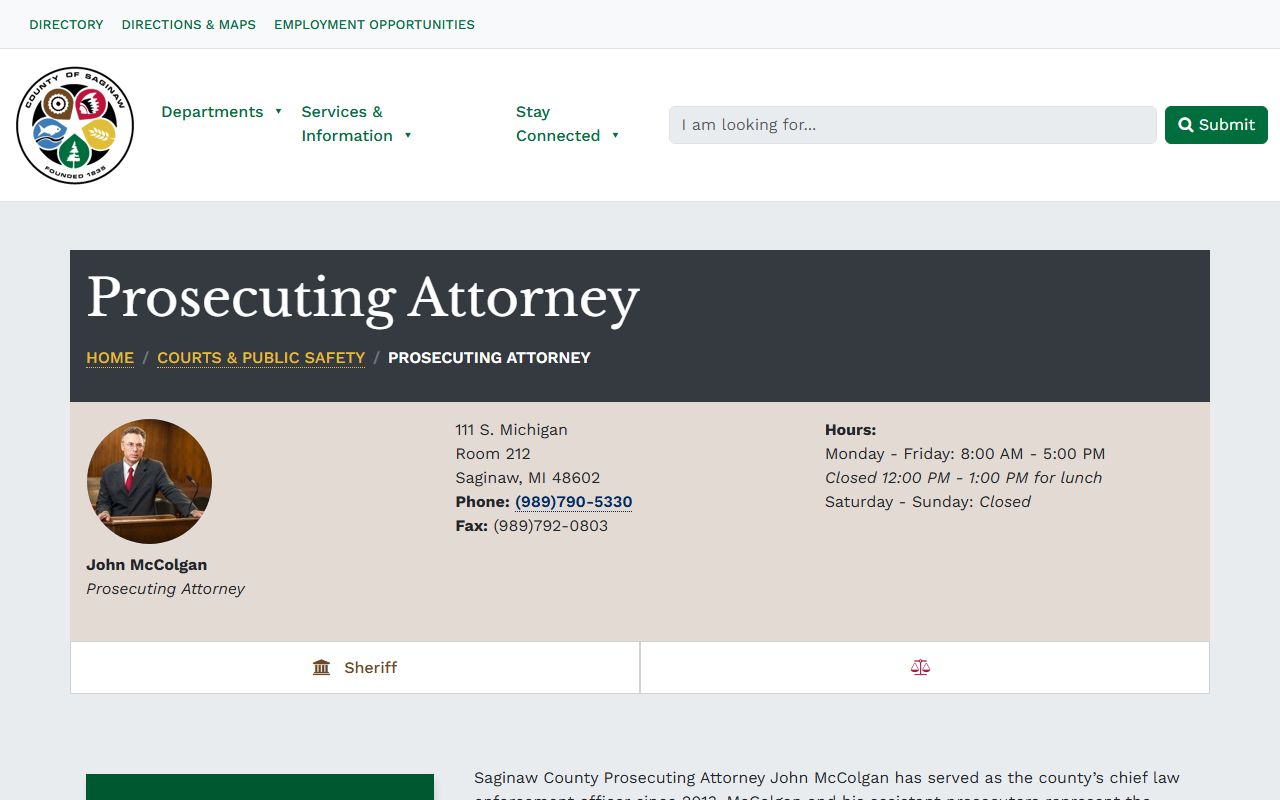
Prosecutor John McColgan leads the office that reviews police reports and issues the complaint and warrant that put charges on the record. Understanding that step is the key to reading any Saginaw County charge record correctly.
Find Saginaw County Arrest Records
Charges and their current status show up in the Saginaw County court case search. The county runs its own Odyssey portal, the Court Case and Hearing Information system. It covers Circuit Criminal, District Criminal, and Traffic cases along with civil and probate matters. The portal shows case and hearing information, but public case documents are not posted online. To read the charge list and see how it has changed, search the case, then request certified copies from the court office if you need the papers themselves.
- Open the Saginaw County Court Case and Hearing Information portal and choose "Search for a Court Case."
- Search by case number when you have it, or by party name in Last, First Middle Suffix order, trying spelling variations.
- Narrow by court using the District Criminal or Circuit Criminal filter, and use the Police Agency field to limit results to the arresting agency.
- Open the case and read the charge list, noting each charge code, severity level, and current status, then complete the reCAPTCHA to run any new search.
The Police Agency filter is unusually detailed and makes the search feel local. It lists the Saginaw City Police Department, the Saginaw County Sheriff Department, the Michigan State Police Tri City Post 31, and township and village agencies such as Bridgeport, Buena Vista, Carrollton, and Kochville. Filtering by the agency that made the arrest is often the fastest way to find the right case when a name is common.
Online results are informational and are not the official record. For certified documents, go to the County Clerk's Circuit Court Division, the District Court, or Probate Court. Circuit Court records from 1985 forward sit in a computerized database open for public inspection. Over-the-counter copies cost $1.00 per page and certification adds $10.00. A mail search runs $10.00 per name with a return envelope, and a criminal record search by mail requires a signed release or a copy of the driver's license.
How Saginaw County Charges Get Filed
The path from arrest to charge follows a set order in Saginaw County. Police investigate first, then send the completed investigation to the Prosecuting Attorney for review. A crime victim cannot file charges directly. A victim who wants charges must first contact police and have a report made, and the decision to issue charges belongs to the Prosecutor, not the victim. Once the Prosecutor decides to move forward, the charge is written into a formal charging document. Michigan uses three main types, and the one that applies depends on how serious the offense is.
| Complaint | Information | Indictment | |
|---|---|---|---|
| What It Is | Written accusation setting forth the specific charges | Formal charging document that replaces the complaint after bindover | Charging document returned by a grand jury |
| Filed By | Prosecuting Attorney | Prosecuting Attorney | Grand Jury |
| When Used | Misdemeanors and the start of felony cases in District Court | Felonies bound over to Circuit Court | Rare in state court; used for some serious felonies |
Most Saginaw County cases start with a complaint. The complaint is a written accusation that a person committed a specified offense, and it sets out the charges. The arrest warrant is the court's order to arrest the defendant and bring the person before the court. The Prosecutor prepares both the complaint and the warrant, and a Saginaw County District Court judge or magistrate signs the warrant. Misdemeanors stay in the 70th District Court. Felonies begin there for arraignment and preliminary examination, then bind over to the 10th Circuit Court if a judge finds probable cause. After bindover, the charges are restated in an information.
Saginaw County Charge Status Terms
Charges are not fixed. They can change as a case moves through the courts. A prosecutor may amend a charge, add or drop counts, reduce a felony to a misdemeanor as part of a plea, or dismiss a count entirely. Reading the status next to each charge tells you where the case really stands, which matters because an early charge often looks different from the final outcome. The Prosecutor's office also handles requests to drop a pending case, and that decision stays with the office rather than the victim.
| Status | What It Means |
|---|---|
| Filed | The charge has been issued and entered on the case; the matter is active. |
| Amended or Reduced | The charge was changed, often lowered in severity, frequently through a plea agreement. |
| Bound Over | A felony was sent from the District Court to the Circuit Court after probable cause was found. |
| Dismissed | The charge was dropped by the court or the prosecutor and is no longer being pursued. |
| Nolle Prosequi | The prosecutor formally declined to proceed on the charge, ending it without a conviction. |
The Prosecutor's public FAQ answers common questions about how charges are filed and dropped and where the office sits inside the Governmental Center. It is a useful reference when a status entry is unclear.
You can review that guidance on the Prosecuting Attorney FAQ page.
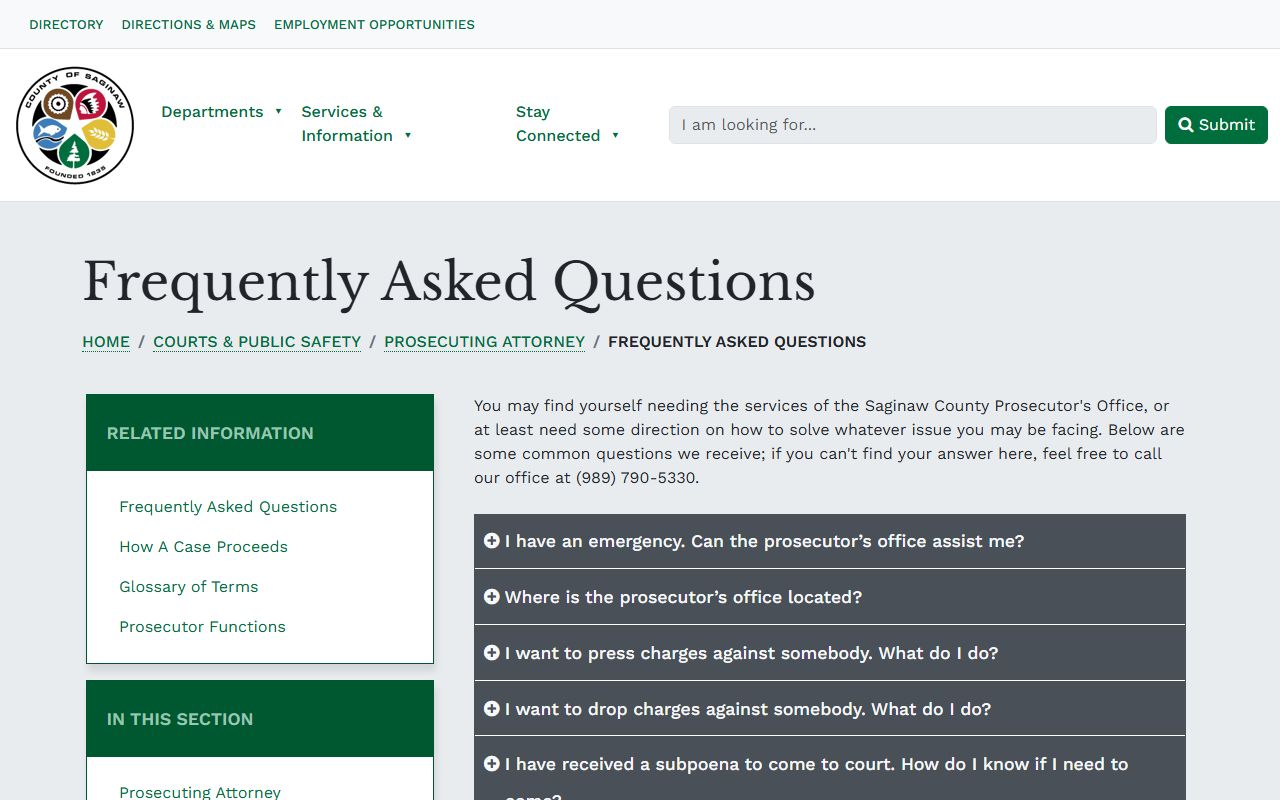
The FAQ confirms that only the Prosecutor issues charges and explains the steps a victim or witness follows, which lines up with what the charge status shows in the case record.
Note: A dismissed or nolle prosequi charge can still appear in the court record as part of the case history even though it did not lead to a conviction.
Saginaw County Charge Codes
Each charge on a Saginaw County record is tied to a specific statute in the Michigan Compiled Laws, which is why a charge line usually pairs an offense name with a code. Michigan sorts offenses into felonies, misdemeanors, and civil infractions. Felonies are the most serious and can carry prison time; they begin in District Court and bind over to Circuit Court. Misdemeanors carry shorter jail terms or fines and are handled in the 70th District Court. Civil infractions, such as most traffic tickets, are not crimes and are resolved through the Traffic Division.
One arrest can produce several separate charges. A single incident might list a felony count, a misdemeanor count, and a related infraction, each with its own code and its own status. That is normal. When you read a case, check every charge line rather than the first one, because the counts can be dismissed, reduced, or resolved on different dates.
Charges vs. Convictions
Being charged is not the same as being convicted, and the difference is easy to miss when a record only shows the opening counts. A charge is an accusation that starts the court process. A conviction is the outcome, reached by a guilty plea or a verdict. Many charges are later reduced, dismissed, or resolved without a conviction, so a charge on its own says little about how a case ended.
| Charge | Conviction | |
|---|---|---|
| Stage | Accusation at the start of the case | Verdict or plea at the end |
| Burden of Proof | Probable cause | Beyond a reasonable doubt |
| What It Proves | Nothing about guilt | Legal guilt as decided by the court |
| Public Record | Yes | Yes |
To follow a charge all the way to its result, look at the disposition and sentence in the full case file. Those entries, along with pleas and hearings, are described on the Saginaw County criminal court records page.
Saginaw County Charge Record Access
Saginaw County charge records are public unless a statute or court order restricts them. Michigan's Freedom of Information Act states a public policy favoring open information about government, though court case records are governed mainly by court rules and the court offices rather than ordinary county FOIA. For records the courts do not hold, such as sheriff administrative files, a FOIA request to the county is the route, keeping in mind that certain law-enforcement records can be withheld.
The Michigan FOIA statement of public policy sets the tone for how the state treats public records.
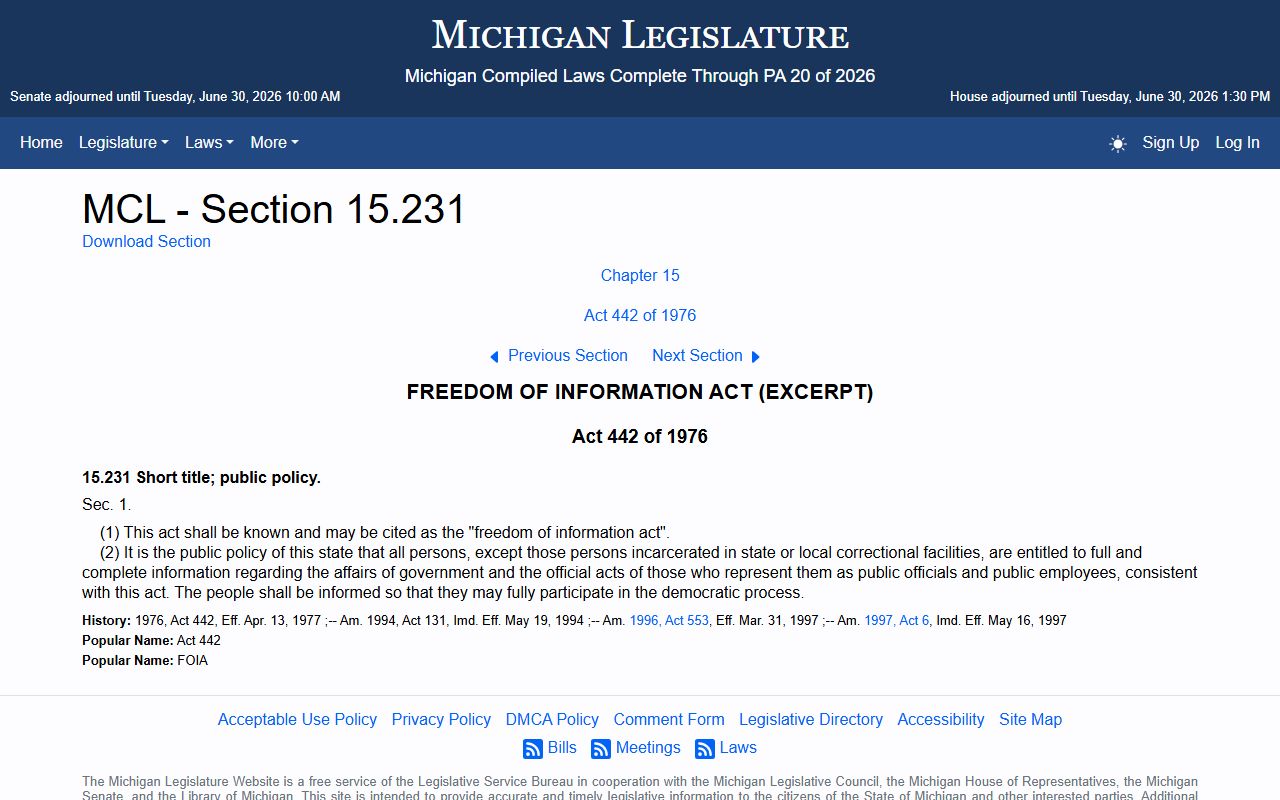
That policy explains why so much charge information is open to the public even when the underlying documents must be requested from a court office. For a statewide picture, charges roll up into a criminal history maintained by the Michigan State Police. The District Court Criminal Division points users to ICHAT, the Internet Criminal History Access Tool, for a fee-based statewide search. ICHAT reports Michigan criminal history, but it is not a live warrant tool and it does not replace the Saginaw County case search for charge status.
Federal Charges and the U.S. Attorney
Not every arrest in the area leads to county charges. Some cases are prosecuted in federal court instead. Saginaw County sits in the U.S. District Court for the Eastern District of Michigan, Northern Division, and the closest federal courthouse is in Bay City. Federal charges are filed by the United States Attorney, not the Saginaw County Prosecutor, and they cover federal crimes rather than state offenses. These cases do not appear in the county Odyssey portal.
The U.S. Attorney's district office describes its role and its Bay City branch.
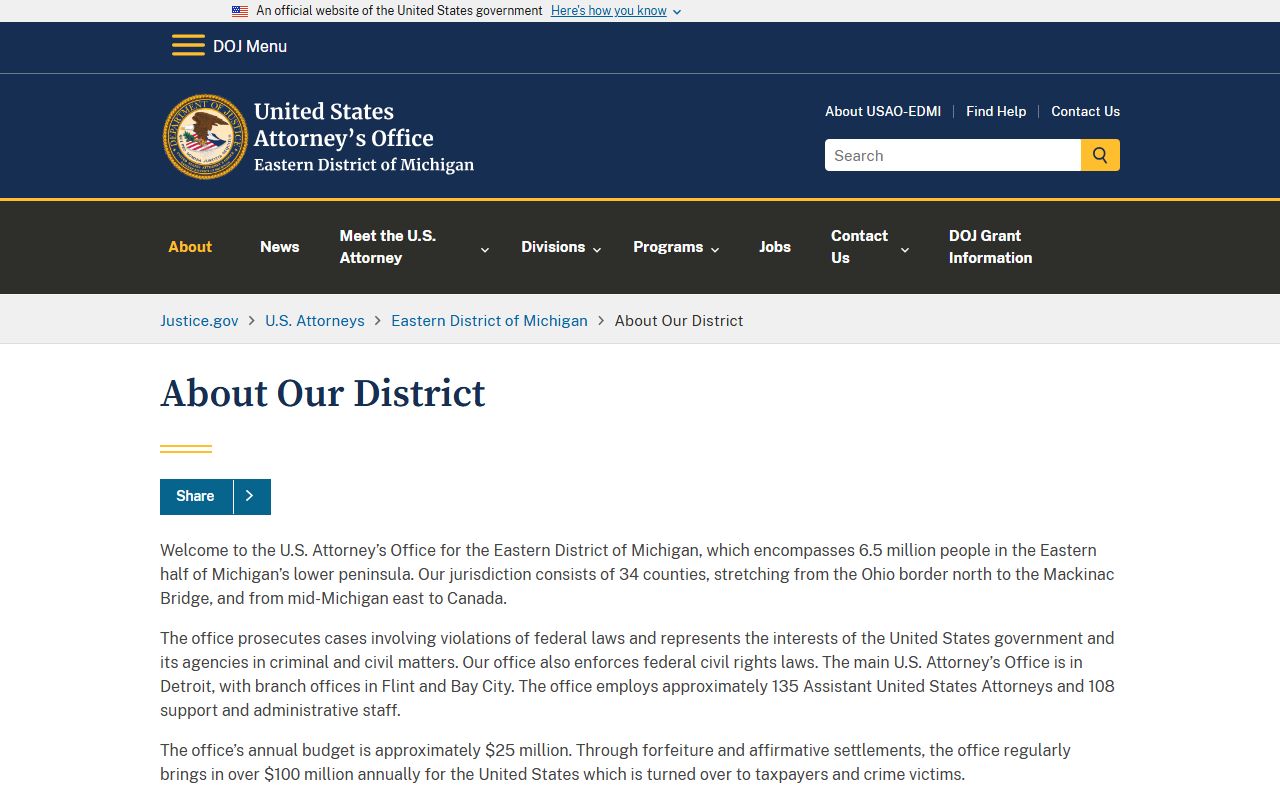
The Bay City Branch Office sits at 101 First Street, Suite 200, Bay City, MI 48708, and can be reached at (989) 895-5712. Federal charge and case records are searched through the federal PACER system rather than the county court search.
Sealed vs. Expunged Records
Not all charge records stay visible forever. Michigan's main tool is the set-aside, often called expungement, which removes an eligible conviction from public view under state law. Sealing, by contrast, hides a record by court order while keeping it in existence. The two are related but not identical, and eligibility differs.
| Sealed | Expunged (Set Aside) | |
|---|---|---|
| Visibility | Hidden from public view by court order | Removed from public view under the set-aside statute |
| Law Enforcement | Limited access | Available for specified court, police, and government uses |
| Eligibility | Set by statute and court order, including many juvenile and sensitive matters | Michigan Clean Slate allows many misdemeanors and up to three eligible felonies after set waiting periods |
A person generally files a set-aside in the court where the conviction occurred, using the statewide application, with a separate filing for each court. Waiting periods depend on the number and seriousness of convictions. A set-aside is not the same as being cleared of the charge, and restitution and some official uses remain.
Getting Legal Help and Running Background Checks
Anyone facing charges after a Saginaw County arrest has the right to counsel. At a District Court arraignment, if a defendant cannot afford an attorney, the judge may appoint one. Indigent defense is requested through the court at arraignment or through the county's Office of Assigned Counsel and the Saginaw Defenders process, not by contacting the Prosecutor. The public defense office publishes general information for people who qualify for appointed counsel.
General information about indigent defense in the county is available on the Saginaw Defenders Office site.

For background checks, the difference between a casual lookup and a formal report matters. A regulated background check for employment, housing, or credit must follow the federal Fair Credit Reporting Act and use a licensed screening company. A quick search of the Saginaw County case portal or ICHAT is fine for personal knowledge, but it is not a compliant background report.
Important: This site is not a consumer reporting agency under the FCRA, and its information may not be used for employment, tenant, credit, or insurance screening.
Restricted Saginaw County Charge Records
Some charge records are not open to general public search. Juvenile matters moved to the Family Division of the Circuit Court and carry special confidentiality rules, so they are not treated like adult criminal charges. Adoption files and many mental health proceedings are confidential as well. Charges that were set aside become nonpublic for ordinary users, though they remain available for certain law-enforcement and government purposes.
Active investigations are the other common limit. Michigan's FOIA exemptions let a public body withhold law-enforcement records when release would interfere with an ongoing proceeding, reveal investigative methods, or invade privacy. That is why an arrest can happen before any charge appears in the public case search, and why an unexecuted warrant may not be visible.
The specific exemptions that protect active law-enforcement records are listed in the Michigan statute.
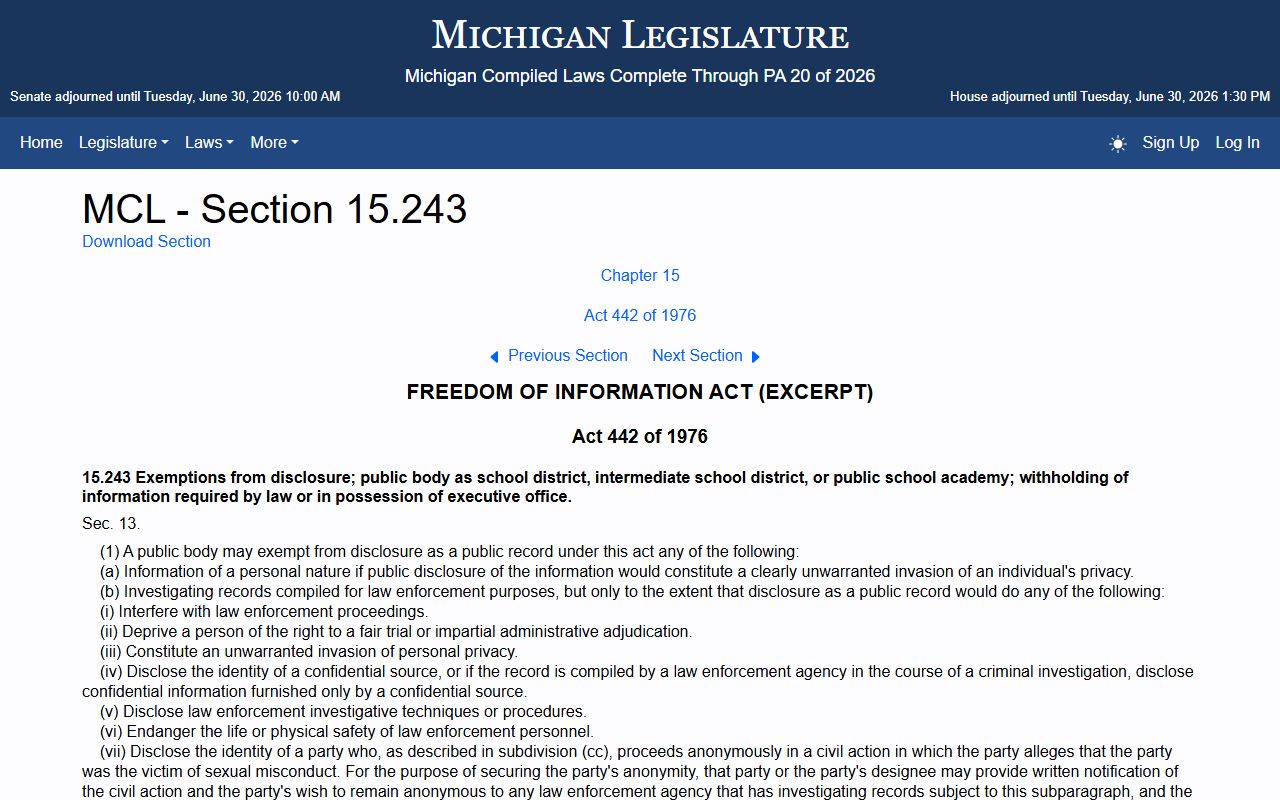
Reading those exemptions makes clear that a missing record does not always mean nothing happened. It can mean the file is restricted while the case is active. When a charge record is sealed, confidential, or still under investigation, the court or the holding agency is the right place to ask.
Note: An arrest without a matching public charge often reflects a case still under prosecutor review or an exemption that shields an active investigation.