
What Probate Covers in Saginaw County
The Saginaw County Probate Court handles legal matters tied to death, incapacity, and protection. Its jurisdiction covers administration of decedents' estates and trusts, adult and minor guardianships, conservatorships, and the involuntary commitment of people who are mentally ill. Michigan established probate courts early, and the 1963 Constitution requires every county organized for a judicial purpose to have a Probate Court. Probate judges are chosen in nonpartisan elections and serve six-year terms.
The court's reach has narrowed over time. Since January 1, 1998, many matters once heard in Probate Court, including juvenile delinquency, neglect and abuse, and adoption, moved to the Family Division of the Circuit Court. Judge Patrick J. McGraw serves as Senior Judge of the Saginaw County Probate Court and also sits on the 10th Judicial Circuit Court. He carries a full probate docket along with personal protection orders, name changes, and the Swift:Sure specialty court that supervises certain felony probationers.
The county's official Saginaw County Probate Court page outlines this jurisdiction, the court's history, and Judge McGraw's role.
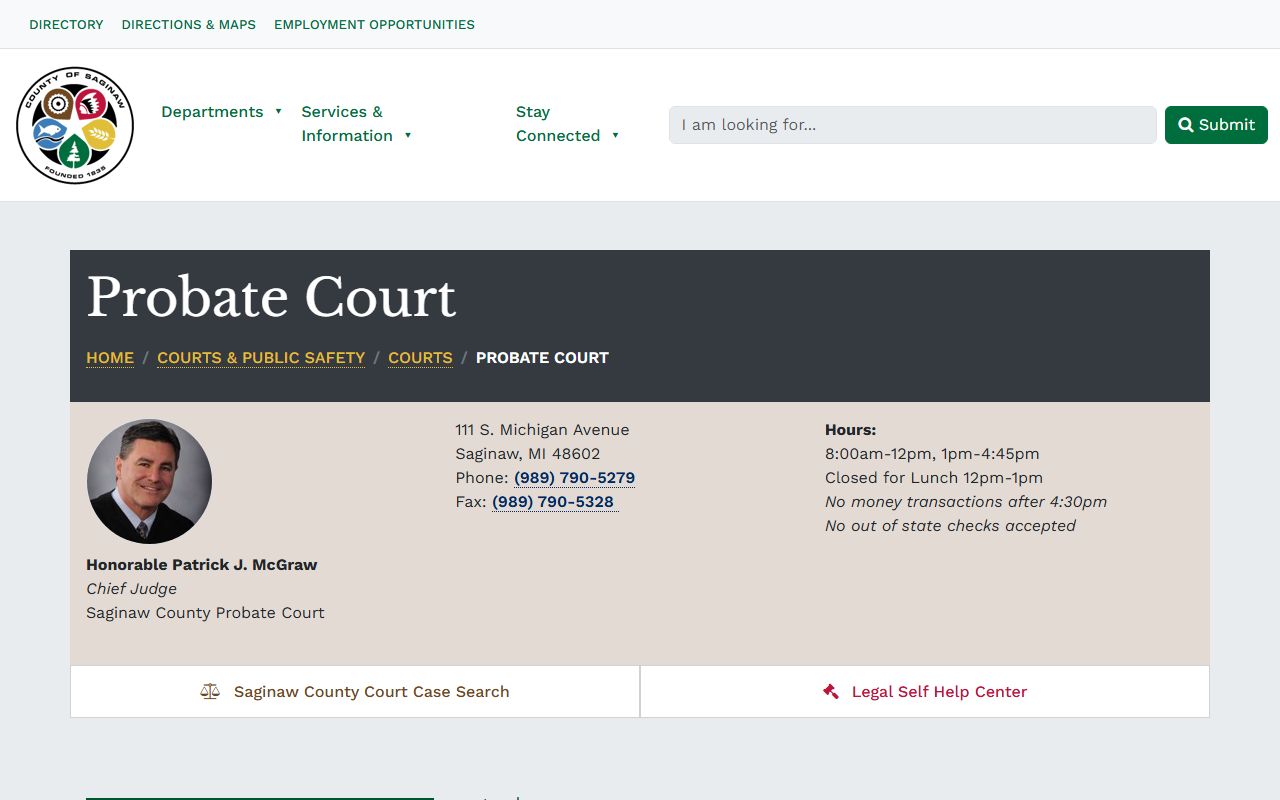
That page is the best starting point for confirming which matters the Probate Court still hears before a file is requested.
Probate Terms Defined
Probate paperwork uses words that rarely appear in daily life. A short glossary helps a first-time reader make sense of an estate or guardianship file before searching for it. The terms below appear on petitions, orders, and letters issued by the Saginaw County Probate Court.
- Testator
- The person who made a will. When that person dies, the will is filed with the Probate Court to be proved and carried out.
- Executor
- The individual named in a will to carry out its terms, pay debts, and distribute property to the heirs.
- Personal representative
- The Michigan term for the person the court appoints to administer an estate, whether or not a will exists.
- Letters of authority
- The court document that proves a personal representative has legal power to act for the estate.
- Intestate
- Dying without a valid will, which means state law decides who inherits and the court appoints the administrator.
- Guardianship
- A court arrangement placing responsibility for the personal care of a minor or an incapacitated adult with an appointed guardian.
- Conservatorship
- A court arrangement giving an appointed conservator control over the money and property of a protected person.
Saginaw County Probate Case Types
The Probate Court groups its work into a handful of case families. Each type follows its own steps, but all of them create a court file that the public can search at the case level. Knowing which family a matter belongs to points a searcher to the right records and the right division for copies.
- Decedent estates: petitions to open an estate, appointment of a personal representative, notices to creditors, inventories, claims, accountings, and closing documents.
- Trust matters: trust administration questions, accountings, trustee disputes, and petitions tied to a trust.
- Guardianships: adult guardianship of an incapacitated person and minor guardianship, including appointment, removal, and modification.
- Conservatorships: financial management for a protected individual who cannot handle money or property.
- Mental health proceedings: involuntary commitment of a person who is mentally ill, a sensitive and restricted part of the docket.
- Name changes and personal protection orders: matters Judge McGraw handles alongside the estate and guardianship dockets.
How to Search Saginaw County Probate Records
Probate case information is searched online through the Saginaw County Court Case and Hearing Information portal, the county's public Odyssey system. The portal offers a case search and a docket search, and it reaches six court types, including Probate. The system holds case and hearing information only. Public case documents are not available online, so a will, inventory, or accounting must be obtained for a fee at the Probate Court office. A reCAPTCHA check gates each search, so lookups are completed by a person rather than an automated tool.
When the portal falls short, the Probate Court and its Estate Division answer questions by phone, and staff can confirm records that do not appear online. Older files and certified copies are handled at the counter inside the Saginaw County Courthouse. The Saginaw County Court Case and Hearing Information portal is the fastest first stop for most probate searches.
- Open the Odyssey portal and choose "Search for a Court Case" for estate and guardianship files or "Search for a Court Docket" for hearing dates.
- Set the Court dropdown to Probate so results stay within the Probate Court.
- Enter a case number when you have one, since it returns the cleanest match.
- When searching by name, type the decedent, ward, petitioner, or protected person in Last, First Middle Suffix order and try spelling variations.
- Complete the reCAPTCHA and select Search, then treat the results as informational.
- Request certified copies or full documents from the Probate Court office, since those files are not posted online.
Probate Search Fields on the County Portal
The case search form gives several ways to filter a probate lookup. Free-text fields accept any part of a case number or a party name, while dropdowns focus the search on a court, a judge, or a display order. Date ranges narrow results by when an estate or guardianship opened or closed. Because most fields are optional, a search can be as broad as one name or as tight as a single case number in the Probate Court.
The Saginaw County case search form places every filter on one screen. The table lists the fields most useful for probate work.
| Field Label | Type | Required | Probate-Specific Use |
|---|---|---|---|
| Case Number (any part) | Text | Validation present | Best way to find a known estate, guardianship, or conservatorship file. |
| Party Name | Text | Validation present | Search a decedent, petitioner, ward, protected person, or interested party if the record is public. |
| Court | Dropdown | Required | Select Probate to limit results to the Probate Court. |
| Filed From / Thru | Date | Can be ignored | Narrow by the date an estate or guardianship opened. |
| Closed From / Thru | Date | Can be ignored | Narrow to closed estate files. |
| Judge or Presiding Official | Dropdown | Optional | Includes Judge McGraw and other current and historic officials. |
| Display Order | Dropdown | Required | Sort results by party, file or close date, judge, or court. |
Reaching the Saginaw County Probate Court
Probate documents that are not online are obtained in person or confirmed by phone. The Probate Court sits inside the Saginaw County Courthouse, and a separate Estate Division line handles estate questions. Calling ahead is wise, since staff can confirm whether a file exists and what a certified copy will cost before a trip downtown. Circuit Court case files, such as divorce judgments tied to a family's affairs, run through the Saginaw County Clerk rather than the Probate Court.
Saginaw County Probate Court
Saginaw County Courthouse
111 S. Michigan Ave.
Saginaw, MI 48602
(989) 790-5279
Estate Division: (989) 790-5320
Hours: Monday to Friday, 8:00 a.m. to 5:00 p.m.
Probate Copies and Filing Fees
Saginaw County has not published a public probate filing-fee schedule, so specific amounts for opening an estate or filing a guardianship petition are confirmed directly with the Probate Court office. Court staff quote current charges when a petition is filed or when copies are requested. The county's general court copy rule gives a rough reference point: for Circuit Court records the County Clerk charges $1.00 per page with a $10.00 certification fee, and a mail record search carries a separate $10.00 fee per name. Probate document and certified-copy costs are set by the Probate Court and given at the counter, so a phone call before visiting saves a wasted trip.
Note: Probate filing fees for Saginaw County are not published online, so confirm current amounts with the Probate Court office rather than relying on any estimate.
What Saginaw County Probate Records Show
A probate file follows a matter from opening to closing, and it captures each formal step along the way. An estate file usually starts with a petition and the will, if one exists, then adds the order appointing a personal representative and the letters of authority that prove their power to act. As the estate moves forward, the file grows to hold notices, an inventory of assets, creditor claims, accountings, and the final orders that close the case and distribute property.
Guardianship and conservatorship files follow a similar arc. They record the petition, medical or evaluation reports where required, the appointment order, and later reports the guardian or conservator files with the court. Common documents found in Saginaw County probate records include the following.
- Wills admitted to probate and petitions to open an estate.
- Orders appointing a personal representative, guardian, or conservator.
- Letters of authority and letters of guardianship or conservatorship.
- Inventories of estate assets and annual accountings.
- Creditor claims, notices, and proofs of service.
- Final orders closing the estate and distributing property.
Restricted Probate Records
Not every probate matter is open to the public. Involuntary mental health proceedings are sensitive and are not treated like ordinary estate files. Some guardianship material and records tied to minors also carry access limits under court rules and orders. Personal identifiers such as Social Security numbers, financial account data, and protected addresses are redacted from files that are otherwise public.
Two categories that many people expect to find in Probate Court now sit elsewhere and stay confidential. Adoption proceedings moved to the Family Division of the Circuit Court after 1998, and adoption records are confidential under MCL 710.67. Juvenile matters carry their own confidentiality rules under MCL 712A.28, so they are not open like adult estate records. For couples researching family history, marriage and divorce documents are vital and circuit records rather than probate files, and they are covered under Saginaw County marriage and divorce records.
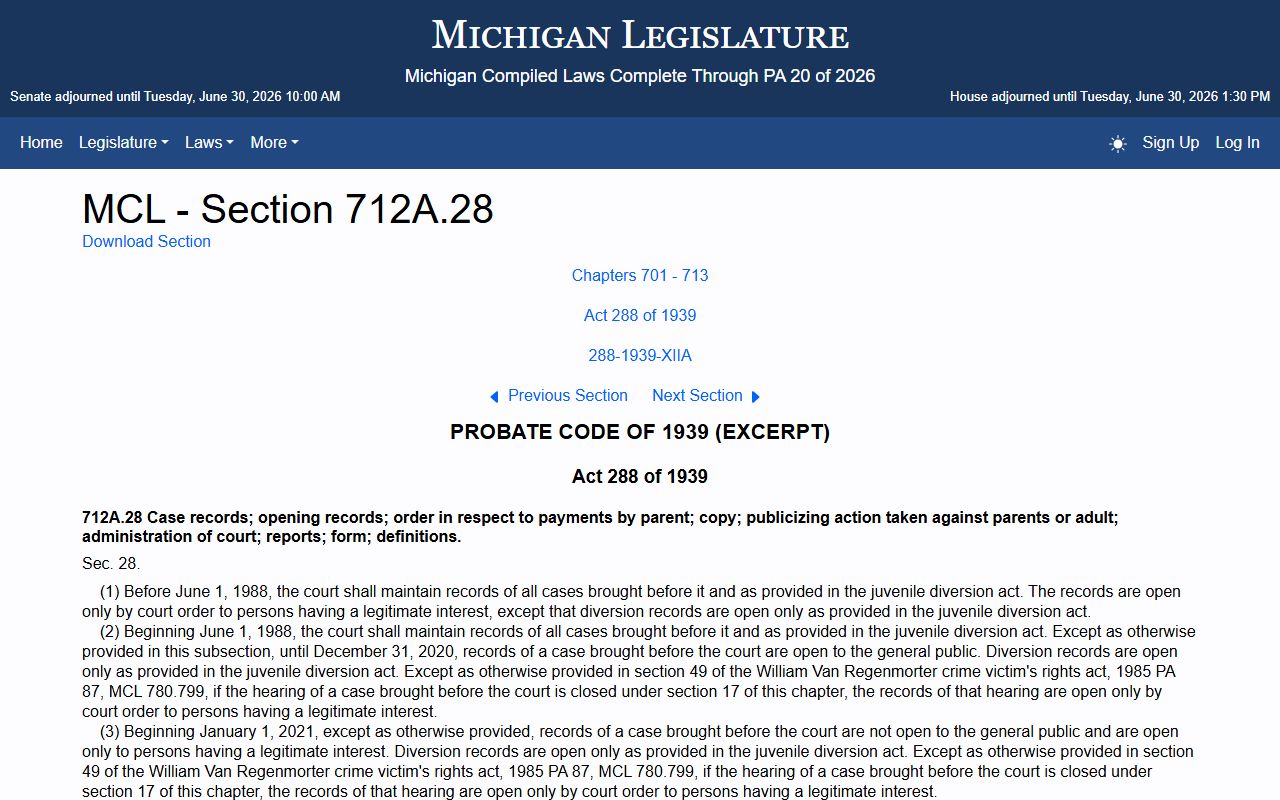
The statute confirms that juvenile records receive special protection, which is why those files never appear alongside open probate cases on the county portal.
Matters That Go to Federal Bankruptcy Court
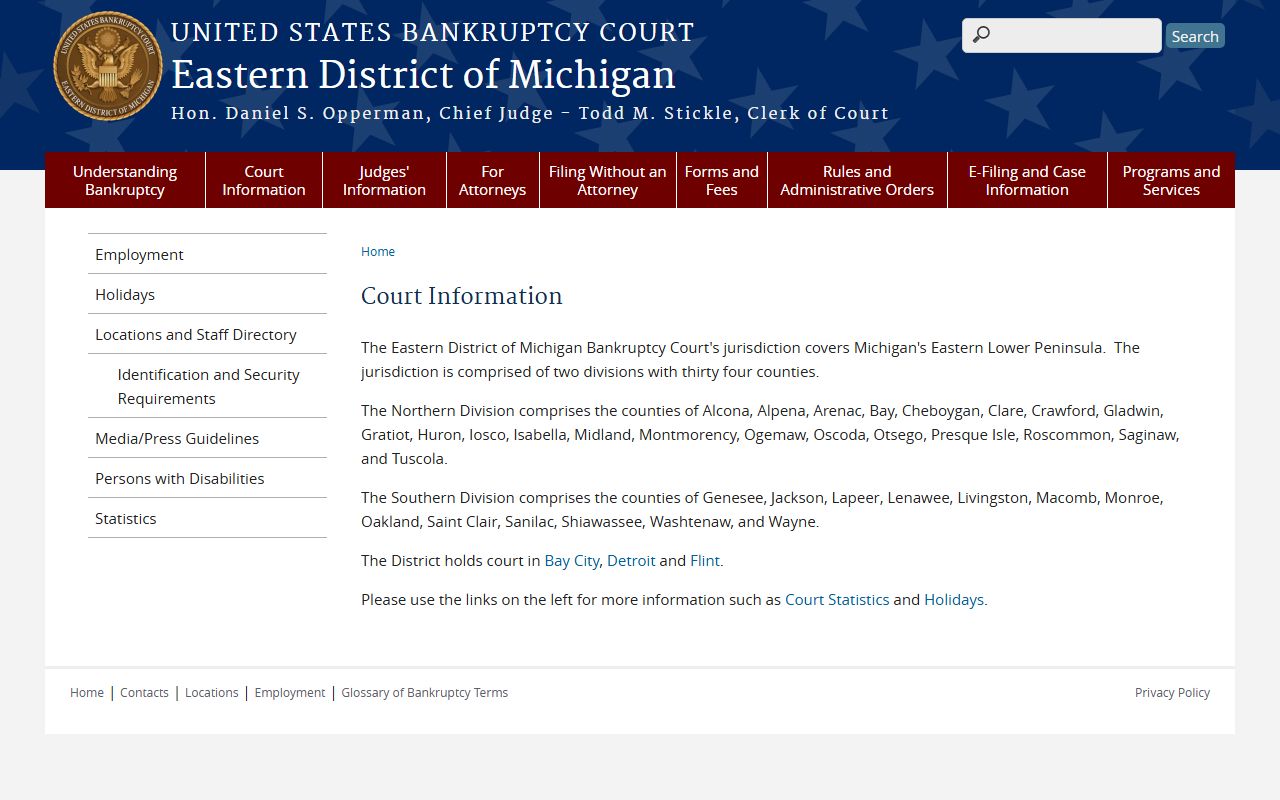
Some money and property matters that feel similar to probate are not county cases at all. Bankruptcy is decided in federal court, not the Saginaw County Probate Court, so a debtor's reorganization or discharge is filed and searched through the federal system. Saginaw County falls in the U.S. Bankruptcy Court for the Eastern District of Michigan, and the court's Northern Division covers the county. When an estate, a guardian, or a family is dealing with insolvency, that side of the matter belongs to the federal court rather than the probate docket.
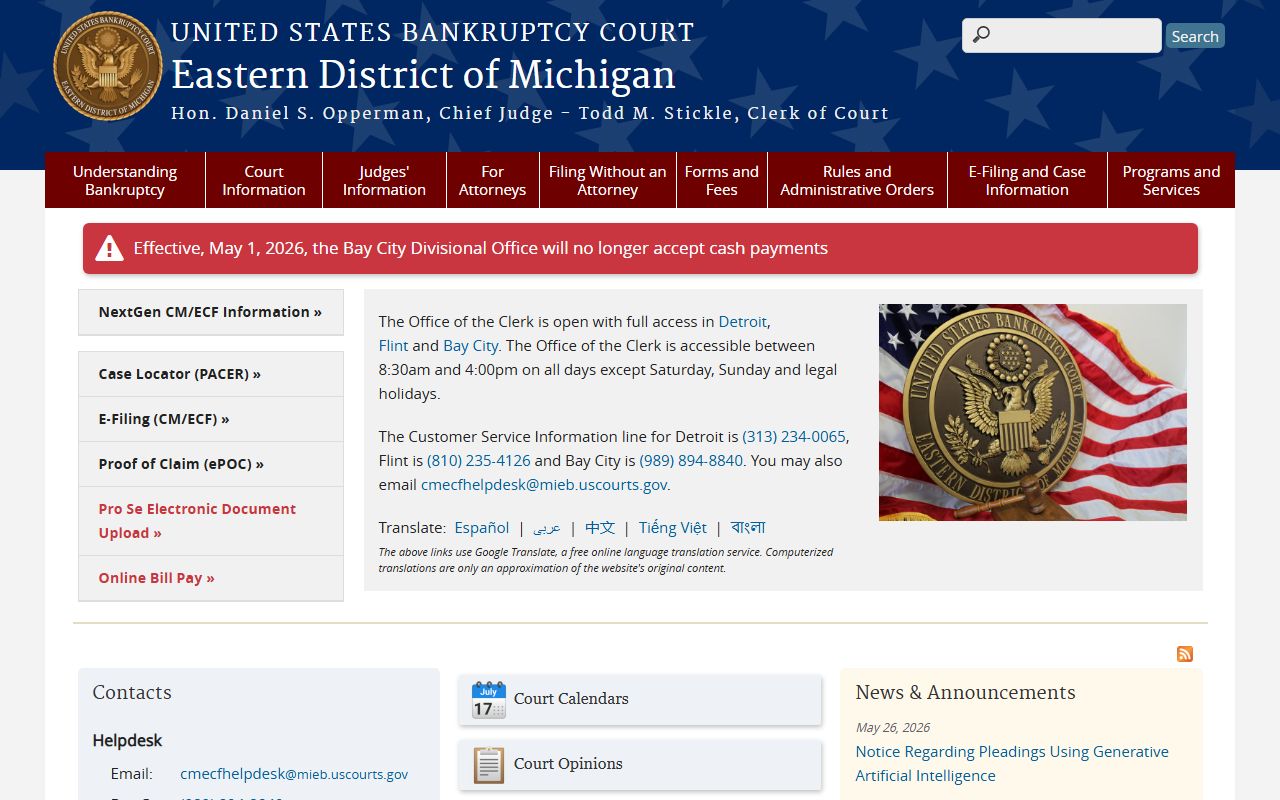
The U.S. Bankruptcy Court for the Eastern District of Michigan publishes filing rules, forms, and locations on its site.
The court's jurisdiction page lists the Northern Division counties, and Saginaw County is named among them.
The nearest federal courthouse for these filings is in Bay City, and its Bay City location page lists the address and hours.
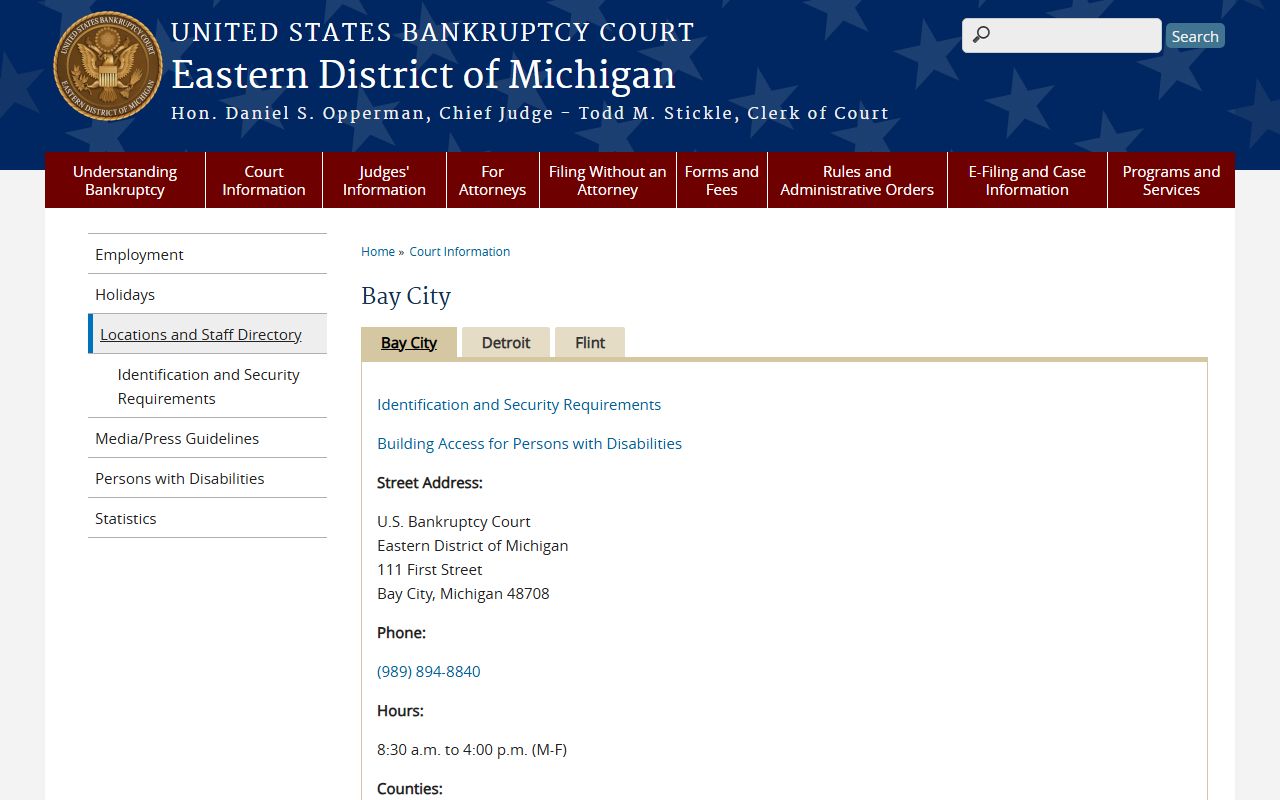
Residents who need to file or search a bankruptcy case use the federal office below, which is separate from the county Probate Court.
U.S. Bankruptcy Court, Bay City
Eastern District of Michigan, Northern Division
111 First St.
Bay City, MI 48708
(989) 894-8840
Hours: Monday to Friday, 8:30 a.m. to 4:00 p.m.