
Criminal Court Records in Saginaw County
A criminal court record is the case file a clerk opens the moment a charge reaches the court. It is not a single page. It is a running record of every filing, hearing, and order in the case, from the complaint through the judgment. In Saginaw County, the County Clerk's Circuit Court Division keeps the official record for felony cases bound over to the 10th Judicial Circuit Court, while the 70th District Court Criminal Division keeps the files for misdemeanors and the early felony stages. These files are the working record used by the judges, and most are open for public inspection.
Two trial courts handle criminal matters here. The 70th District Court is a limited-jurisdiction court that hears misdemeanors, which generally carry up to one year in jail, and it also handles the arraignment and preliminary examination for adult felonies. The 10th Judicial Circuit Court is the felony trial court. Once a District Court judge finds probable cause, the felony is bound over to the Circuit Court, where the case moves through arraignment on the information, pretrial, trial or plea, and sentencing. Circuit Court records from 1985 to the present sit in a computerized database.
The 70th District Court Criminal Division page explains how misdemeanors and early felony stages are processed in the county, and it is a useful starting point for record research. Open the 70th District Court Criminal Division page for that overview.
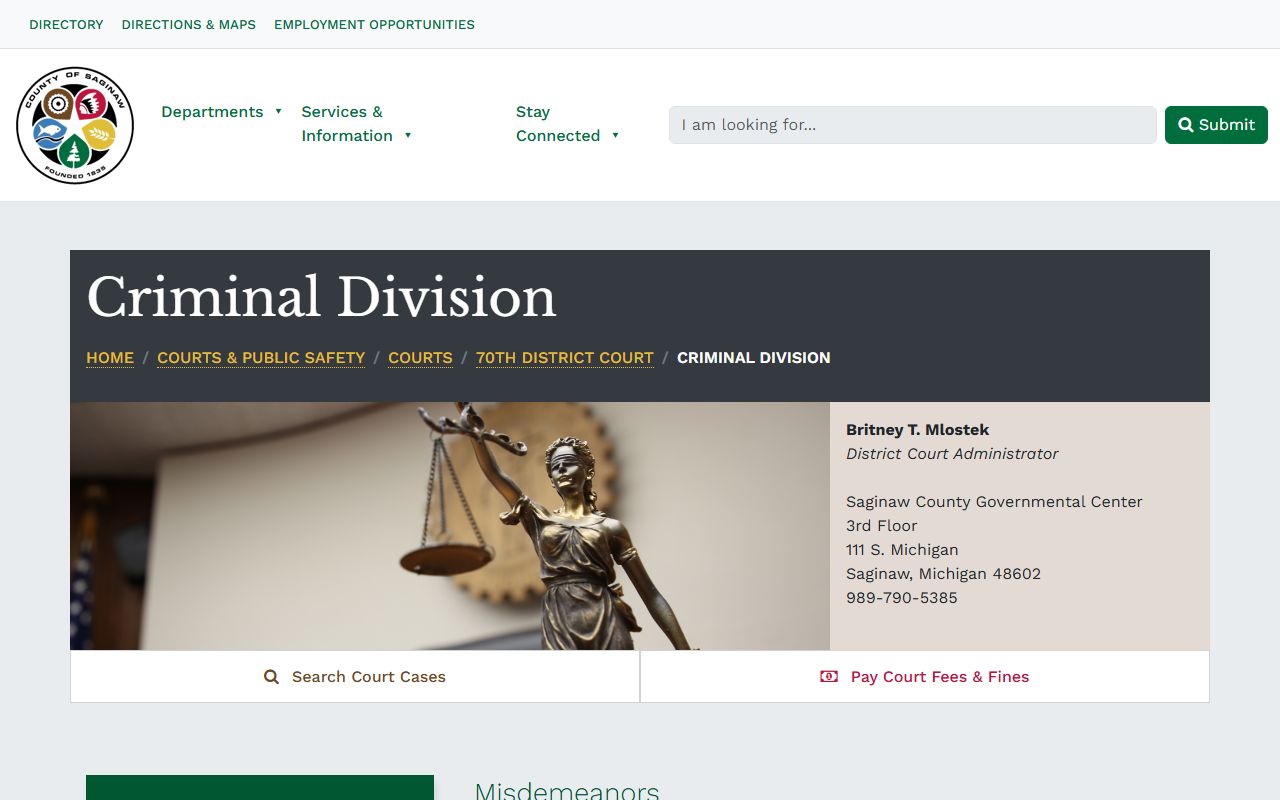
That division counter is where misdemeanor case files, bonds, and arraignment records are managed before a case is ever searched online.
How a Saginaw County Criminal Case Proceeds
Every criminal court record tells the story of a case in the order it happened, so it helps to know the stages a Michigan case passes through. A felony and a misdemeanor share many of the same steps, but a felony adds a preliminary examination and a bindover from the District Court to the Circuit Court. Each step leaves an entry in the file, which is why a docket can run for pages.
Case flow: Complaint / Warrant › Arraignment › Preliminary Examination › Bindover › Circuit Arraignment on the Information › Pretrial › Plea or Trial › Disposition › Sentencing
The Saginaw County Prosecuting Attorney publishes a plain overview of this sequence, from arrest and booking through appeals. Read the office summary of how a case proceeds to see where each record is created.
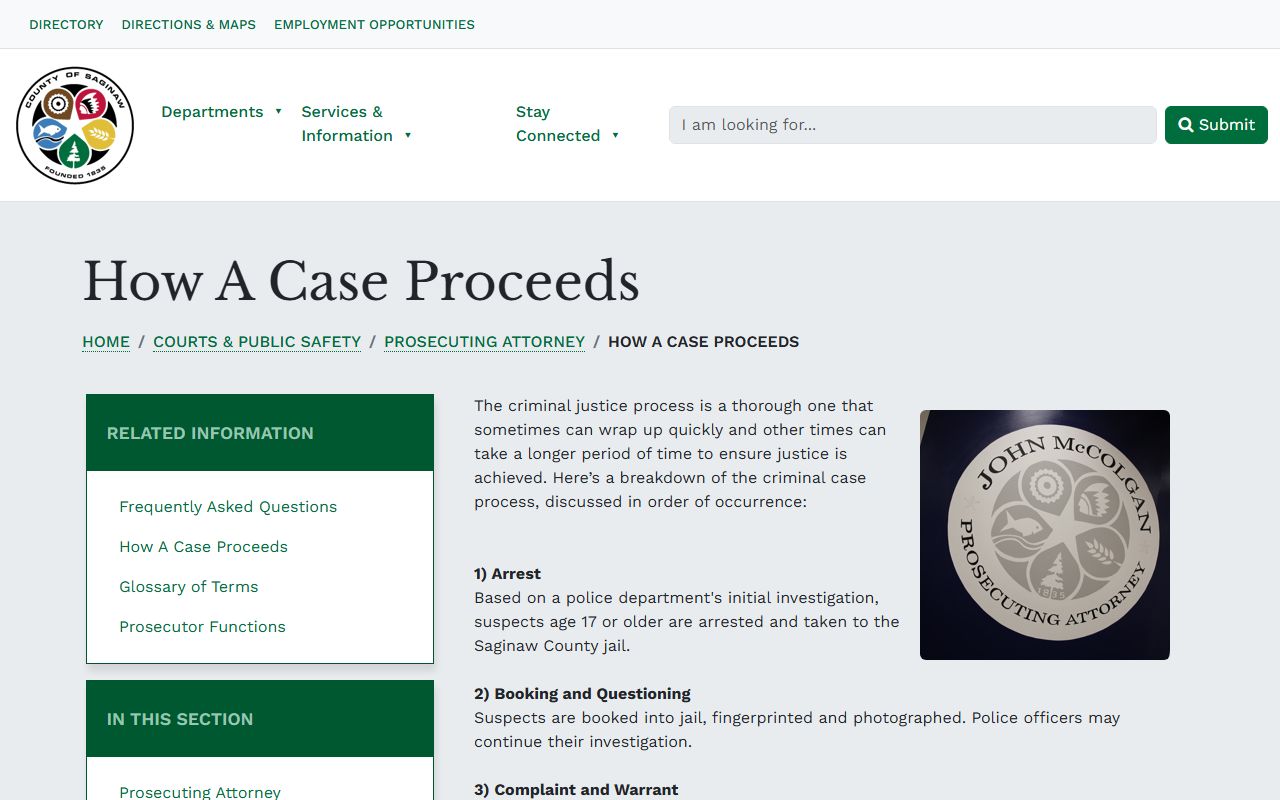
The stages below map that flow to the entries a reader will find in a Saginaw County criminal court record.
| Stage | What Happens |
|---|---|
| Complaint & Warrant | The prosecutor prepares a written complaint stating the specific charges, and a District Court judge or magistrate signs the arrest warrant. |
| Arraignment | The defendant is told the charges, the possible penalties, and their rights. The judge sets bond, and an attorney may be appointed if the defendant cannot afford one. |
| Preliminary Examination | For a felony, this probable-cause hearing is usually held within 21 days of arraignment unless waived. The judge decides whether the case moves forward. |
| Bindover | When probable cause is found or the exam is waived, the felony is transferred from the 70th District Court to the 10th Circuit Court. |
| Arraignment on the Information | In the Circuit Court, the defendant answers to the information, the formal felony charging document filed after bindover. |
| Pretrial & Motions | Conferences and written motions address plea offers, evidence, scheduling, and legal questions before trial. |
| Plea or Trial | The case ends in a plea or goes to trial, where a verdict of guilty, not guilty, or a dismissal is entered. |
| Sentencing | After a conviction, the judge imposes the sentence, which may include jail or prison, probation, fines, costs, and restitution. |
How to Search Saginaw County Criminal Records
The official starting point is the Saginaw County Court Case and Hearing Information portal, an Odyssey system that covers Circuit Criminal and District Criminal cases along with civil, probate, and traffic matters. The portal lets anyone look up case and hearing information for free, but it carries an important limit: the public case documents are not available online. Search results confirm that a case exists and show its status, while the actual filings are obtained for a fee at the court office. Open the Saginaw County case and hearing portal to begin.
- Open the county case portal and choose "Search for a Court Case" for case-level records or "Search for a Court Docket" for hearing dates.
- Enter a defendant name in "Last, First Middle Suffix" order, or use any part of the case number, which the portal recommends because names can be unreliable.
- Set the Court filter to Circuit Criminal or District Criminal to narrow the search to criminal matters, and add a filed or closed date range if known.
- Use the Police Agency filter to focus on a specific department, then complete the reCAPTCHA and submit the search.
- Open a case to read the register of actions and disposition, then request a certified copy from the clerk if the document itself is needed.
The portal warns that name searches can match two people who share a name and birth date, and that offenders sometimes use aliases, so trying spelling variations improves results. For a statewide view, the MiCOURT Case Search covers many participating Michigan courts, and the Michigan State Police ICHAT tool provides a statewide criminal history record for a fee. For anyone sentenced to state prison, the Michigan Department of Corrections OTIS offender lookup shows custody and sentence details that a county file does not.
Getting Saginaw County Criminal Record Copies
Because the documents are not online, the record itself comes from the court office that holds it. Felony case files are handled by the County Clerk's Circuit Court Division, and misdemeanor files are handled by the 70th District Court Criminal Division. Both are inside the Governmental Center on South Michigan Avenue, and both can produce copies over the counter or by mail. A criminal record search by mail has an extra rule: the office requires a signed release form or a photocopy of the person's driver's license before it releases criminal results.
Over-the-counter Circuit Court copies cost one dollar per page, and certification adds ten dollars. A record search by mail carries a ten-dollar search fee for each name, and a return envelope should be enclosed. For misdemeanor case questions and copies, the District Court Criminal Division line is the direct contact.
The Circuit Court Division files every felony case and keeps the record of proceedings for the 10th Circuit Court. See the Circuit Court Division page for its copy and mail-request rules.
What a Saginaw County Criminal Court Record Shows
A criminal court record collects the same core fields whether the case is a misdemeanor or a felony. The public case portal is built around these fields, and the paper or certified file expands on them. Reading a record well means knowing what each field is meant to answer, from who is charged to how the case ended.
| Field | What It Shows |
|---|---|
| Case Number | The unique identifier for the case, searchable by any part; the most reliable way to pull the correct file. |
| Court | Whether the case sits in Circuit Criminal or District Criminal, which tells you the level of the offense. |
| Defendant | The person charged, listed in the party field in Last, First Middle Suffix order. |
| Charges | The specific offenses named in the complaint or information, including counts that may later be amended or dropped. |
| Judge & Police Agency | The presiding official and the arresting or issuing agency, such as the Saginaw County Sheriff or a city police department. |
| Bond | The release status set at arraignment, from personal recognizance to cash or surety bond. |
| Plea | How the defendant answered the charges: guilty, not guilty, or no contest. |
| Disposition | The case outcome, such as convicted, acquitted, dismissed, or resolved by plea. |
| Sentence | The penalty imposed after conviction, including jail or prison, probation, fines, costs, and restitution. |
The register of action is the running index of every filing and hearing, and the clerk lists it at one dollar per page. Financial entries also live in the file, covering fines, court costs, restitution, and bond, because the Circuit Court Division both records proceedings and collects and disburses court money.
Charges vs. Convictions
Being charged is not the same as being convicted, and a criminal court record shows both. A charge is only an accusation. The same file may show charges that were dropped, dismissed, or that ended in an acquittal, which is why reading the disposition matters as much as reading the charges. The decision to bring or drop charges belongs to the Prosecuting Attorney, not to a victim or the arresting officer. For a closer look at the charging documents themselves, see the Saginaw County court charge records page.
| Charge | Conviction | |
|---|---|---|
| Stage | Accusation filed by the prosecutor | Verdict or accepted plea entered by the court |
| Burden of Proof | Probable cause | Beyond a reasonable doubt |
| Can Change | Amended, reduced, or dismissed | Final unless appealed or set aside |
| Public Record | Yes | Yes |
The Prosecuting Attorney's office explains the range of duties behind these decisions. Review the office's prosecutor functions page for that context.
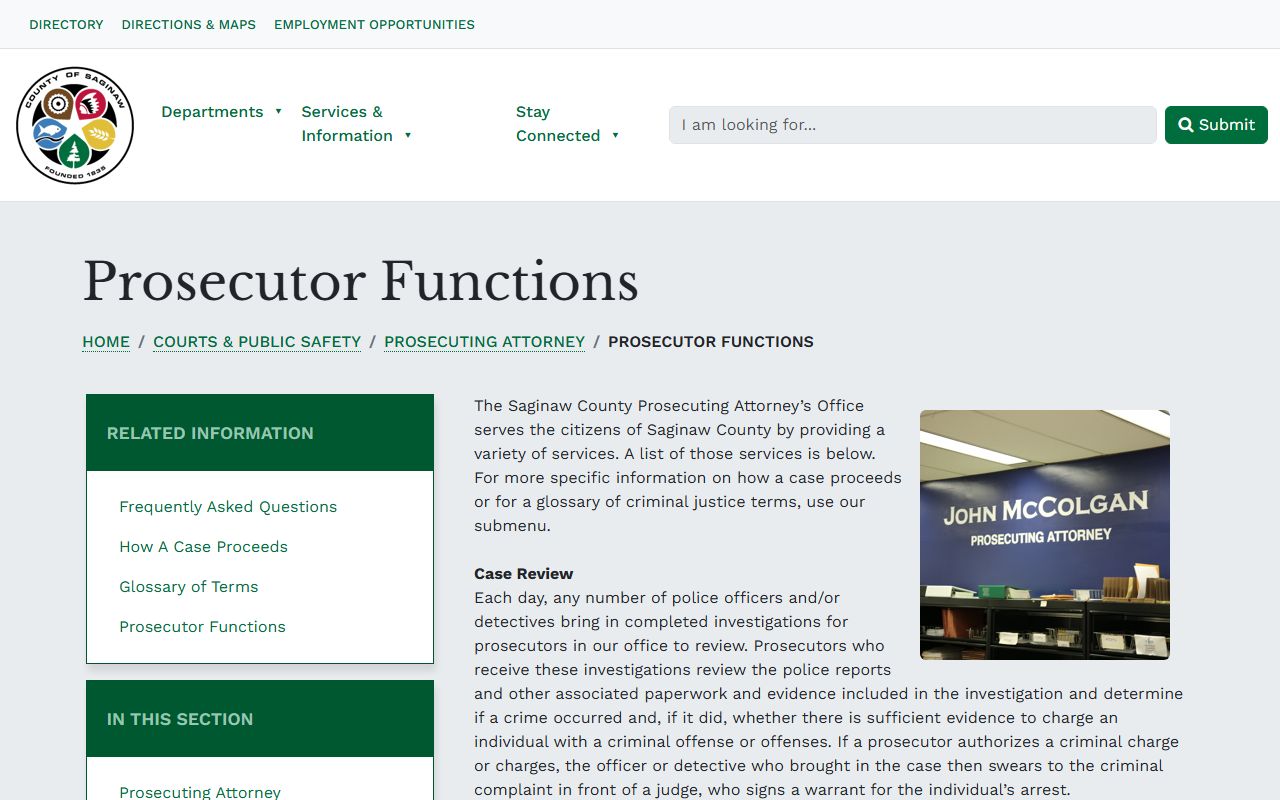
Understanding who files charges helps a reader tell an early accusation apart from a proven conviction in the record.
Reading Saginaw County Criminal Dispositions
The disposition is the field that tells you how a case ended, and the sentence tells you what followed a conviction. These two lines carry the most weight in any criminal court record, yet they use terms that are easy to misread. A few plain definitions clear up most of the confusion.
- Guilty plea
- The defendant admits the charge, and the court enters a conviction without a trial.
- No contest
- The defendant does not admit guilt but accepts the penalty; it is treated as a conviction in the criminal case.
- Dismissed
- The charge is dropped and no conviction is entered, though the case still appears in the record.
- Acquittal
- A trial ends in a not-guilty finding, and no conviction results.
- Probation
- A supervised sentence served in the community instead of, or after, time in custody.
- Restitution
- Money the court orders a defendant to pay to compensate a victim.
A sentence line often bundles several penalties at once. A single conviction can list jail or prison time, a term of probation, fines, statutory costs, and restitution together. Saginaw County also runs problem-solving courts, including a Swift and Sure Sanctions Probation Program that intensively supervises certain felony probationers, so a record may reflect a treatment or supervision track rather than a straight custody sentence.
Sealed vs. Expunged (Set-Aside) Records
Michigan uses the term "set aside" for what many people call expungement, and it works differently from simply sealing a case. A sealed record is hidden from public view by court order but still reachable by courts and law enforcement. A set-aside removes an eligible conviction from the public record so that, for most purposes, it is treated as though it never happened. A set-aside is not the same as being found innocent, and some obligations, such as restitution, remain.
| Sealed | Expunged (Set-Aside) | |
|---|---|---|
| Visibility | Hidden from public view | Removed from the public record |
| Law Enforcement | Still accessible | Retained for limited court, police, and government use |
| Legal Effect | Case still exists | Treated as though the conviction never occurred for most purposes |
| How It Happens | By court order in specific case types | By application under MCL 780.621 using SCAO form MC 227 |
A person generally files a set-aside application in the court where the conviction happened, and a separate application is needed for each court. The controlling statute is the adult conviction set-aside law; read MCL 780.621 for the eligibility framework.
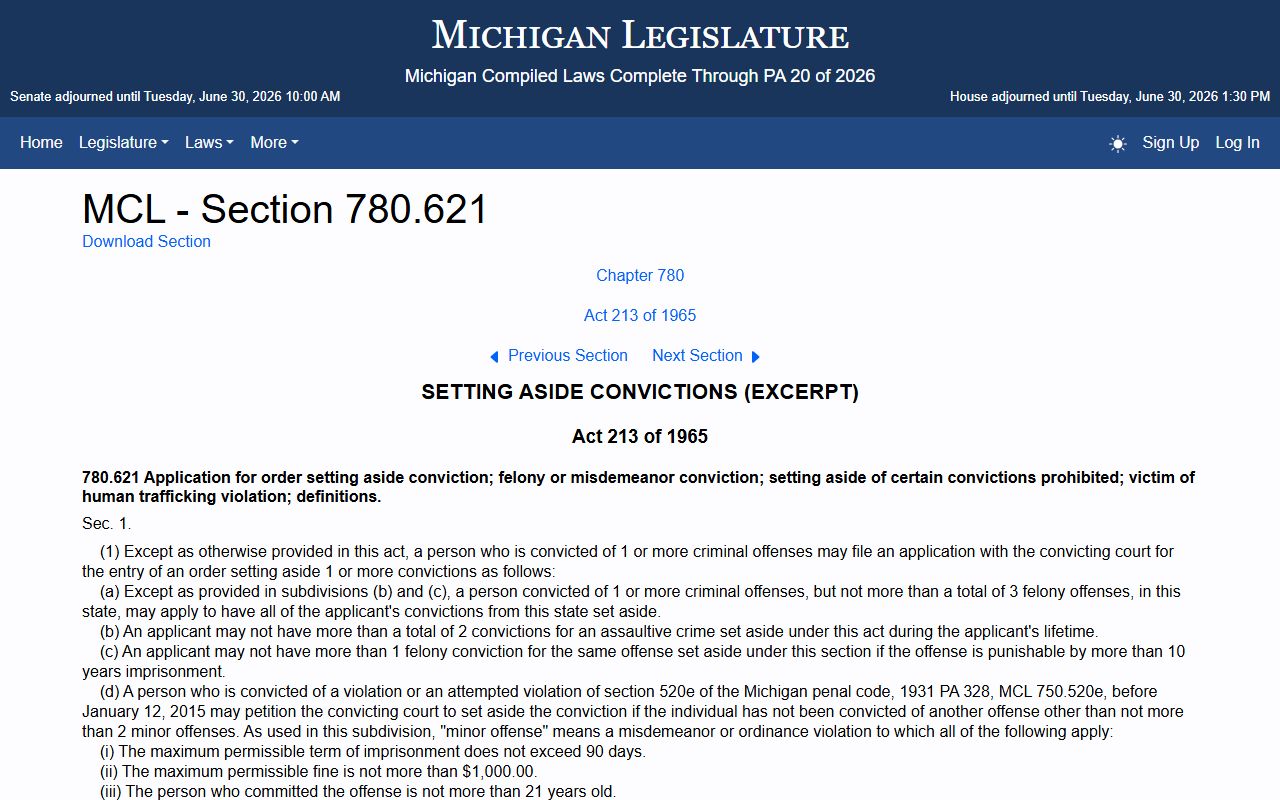
Michigan's Clean Slate reforms widened eligibility to many misdemeanors and up to three felonies. Common waiting periods run three or more years for one or more minor misdemeanors, five or more years for a single felony or serious misdemeanor, and seven or more years for more than one felony, measured from the latest of sentence, imprisonment, probation, or parole discharge. The statewide MC 227 application controls the filing path, with separate forms for marijuana misdemeanors and human-trafficking-victim requests.
Public Access to Saginaw County Criminal Records
Michigan treats criminal case files as public court records, but access runs through court rules rather than ordinary county records law. The clerk maintains the files and provides public inspection under the court-record rules, while the state Freedom of Information Act is the fallback for administrative and law-enforcement records that are not part of a court case. All of these criminal case files are open unless a statute or court order restricts a specific record.
Key Statutes:
Michigan Court Rule 8.119 - Court clerks maintain court records, and public inspection is handled under the court-record access framework.
Michigan Court Rule 1.109 - Defines court records broadly and ties public access back to the clerk's record framework.
MCL 15.231 - States Michigan's public policy favoring full disclosure of records held by public bodies.
MCL 15.243 - Lists FOIA exemptions, including law-enforcement records whose release would interfere with proceedings or invade privacy.
For a wider view of every record the courts hold, the Saginaw County court records overview explains the portal, the fee rules, and the offices that keep each file.
Background Check Considerations
A casual case lookup and a formal background check are not the same thing. Reading a criminal court record online tells you about one case in one county, and it may not capture out-of-county cases, sealed matters, or the most recent activity. A legally regulated background check for employment, housing, or credit must follow the federal Fair Credit Reporting Act and usually runs through a licensed screening company. For a statewide criminal history, ICHAT is the official channel.
Important: This site is not a consumer reporting agency under the FCRA, and its information cannot be used for employment, housing, credit, or other FCRA-regulated decisions.
Restricted Criminal Court Records in Saginaw County
Not every criminal-related record is open. Michigan law shields several categories from ordinary public access, and the court will withhold or redact them even when the rest of a file is public. Knowing what is closed prevents wasted requests and explains why some cases return little or nothing in a search.
- Juvenile cases, which are handled through the Circuit Court Family Division and are confidential under MCL 712A.28.
- Sealed and set-aside convictions, which are removed from public view but remain available for limited court and law-enforcement use.
- Involuntary mental health proceedings, which are sensitive probate matters and are not treated like ordinary case files.
- Personal identifiers such as Social Security numbers, financial account data, protected addresses, and minor names, which are redacted under court rules.
- Active law-enforcement records and unexecuted warrants, which FOIA can protect when release would interfere with an investigation.
When a record is restricted, the court office can confirm whether any part is releasable and what proof or authorization a request requires. Traffic set-aside is limited too, and offenses such as operating while intoxicated are handled differently from ordinary eligible convictions.